

Quick Answer
Yes, if the 10 hours go into the salesperson's own leads rather than generic demos. In a 10-hour Assistify program, a sales consultant at an international moving company built a flow that drafts a reply to every new enquiry and set up 3 Copilot agents. The habit takes longer: it comes from practice on live work.
Owners of service businesses keep hearing that their teams should use AI, and sales is where most firms start. A sales role is a good test: enquiries arrive every day, replies follow a pattern, and a slow first answer can cost the job. Federal research shows where AI use concentrates today.
Data Point
Census Bureau researchers found that 18% of US firms used AI in at least one business function between November 2025 and January 2026. Among firms using AI, sales and marketing was the most common function (52%).
U.S. Census Bureau, Center for Economic Studies working paper CES-WP-26-25 (2026)
What can a salesperson build with AI in 10 hours?
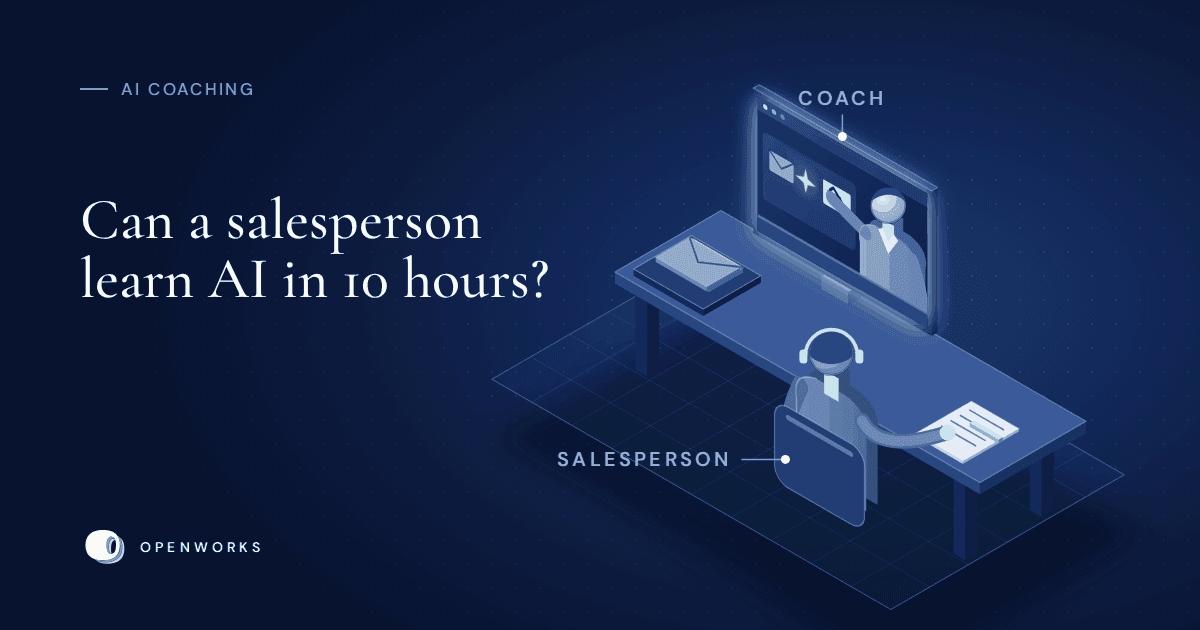
A working lead-response system, if every session uses real enquiries. Over five sessions in two weeks, the consultant mapped his leads, compared AI tools, set rules for customer data and built the system himself, with a coach beside him.
- Session 1: mapped five lead sources and the full reply process.
- Session 2: compared ChatGPT, Claude, Gemini and Copilot, and set rules for using AI with customer data.
- Session 3: scored ten AI ideas by time saved, risk and effort, and picked where to start.
- Session 4: built Outlook rules and a Power Automate flow that drafts a reply to each new lead and records it in a lead log.
- Session 5: added a video-survey booking link to every draft and set up three Copilot agents for replies, inventory and lead research.
“I genuinely thought the course was amazing and I learned a tremendous amount over the two weeks. It opened my eyes to what is possible with AI and gave me a solid foundation.”
Who decides what the AI sends to a customer?
The salesperson does, every time. OpenWorks's criterion is that the AI drafts and a person decides: the flow prepares each reply, and the consultant reads it, checks the recipient and sends it himself. Customer details stay inside the company's Microsoft environment, never in a personal AI account. Portal leads get one extra check, because the portal sends the original email, not the customer.
Why did he ask for more practice after 10 hours?
Ten hours build the system, and daily use builds the habit. Back in his routine, the consultant wrote that he needed more time before relying on the tools with confidence, and he asked for extra hands-on sessions on troubleshooting and live leads. OpenWorks's criterion is that this is the normal second step, not a sign that the first one failed.
“I've already started using the tools in my daily work and can see the potential, so I'm looking forward to continuing the learning process.”
What should an owner expect from 10 hours of AI coaching?
Expect a working first system and a person who understands it, not a finished transformation. The table below, based on what OpenWorks observed in this program, separates what the 10 hours delivered from what the practice stage still has to cover.
| After 10 hours | Still needs practice |
|---|---|
| A flow that drafts and logs every new lead | Fixing the flow alone when a step fails |
| Three Copilot agents ready to use | Using the agents on live leads every week |
| Rules for customer data and review | Follow-ups after 3 and 7 days |
| A ranked list of next AI ideas | A weekly lead report for his manager |
Can job-based AI training be part of a return-to-work plan?
Yes, and the consultant sees his case as an example. He took the program as part of a vocational rehabilitation plan, and he notes that such plans often rely on general computer courses or physical rehabilitation. This training was tied to the job he already held, so he could apply the skills at work right away. OpenWorks's criterion is that training built on a person's real tasks is easier to apply than general software lessons.
How does OpenWorks coach a team to use AI with Assistify?
Assistify is OpenWorks's one-on-one AI coaching, built so that an owner and team create their own AI solutions on their real work. A coach works with the person who does the task, so the skills and what gets built stay inside the company. Each program is set around the client's own tools and data rules, and a person, not the AI, approves anything that reaches a customer. When a solution needs more hands, OpenWorks can add dedicated developers in Latin America who work only for the client, in the client's time zone. The comparison below sets that approach against hiring someone locally for the same job.
| Factor | Hiring locally | AI coaching with Assistify (OpenWorks) |
|---|---|---|
| Who builds the solutions | A local hire or a consultant | The owner and team, with a coach |
| Where the know-how stays | With the specialist you hire | With the owner and team |
| How support runs | A new local role | One-on-one coaching sessions |
| When more hands are needed | Another local hire | Dedicated developers in Latin America, in your time zone |
Key Takeaway
Ten hours of coaching on real leads can give a salesperson a working AI system. Plan for the practice that follows, because the daily habit, not the build, is what makes the system part of the job.
Frequently Asked Questions
What does AI coaching for a sales role cover?
It starts with the salesperson's own lead flow: where enquiries come from and how replies go out. From there, a coach helps the person compare AI tools, set rules for customer data, choose the first task worth automating and build it on real enquiries. In the case above, that took five sessions and 10 hours.
Does the team need new software to start?
Not necessarily. The consultant in this case built his system with Outlook rules, Power Automate and Microsoft Copilot, tools his company already used. New software makes sense only when a clear process shows a gap that current tools cannot fill. Company IT policies can limit some features, so it helps to check them early.
Is it safe to use AI with customer information?
It can be, with clear rules. OpenWorks's criterion is to keep customer details inside the company's approved AI tool, never in a personal account, and to have a person read every reply before it goes out. Removing names, emails and phone numbers before pasting an enquiry into a general chatbot adds another layer of protection.
How many hours of coaching does a salesperson need?
OpenWorks does not promise a number, because it depends on the person and the task. In this case, 10 hours produced a working system, and the consultant then asked for more hands-on sessions to build confidence on live leads. A sound plan budgets for a build stage and a practice stage.
An owner can start by choosing one person and one daily task, such as replying to new enquiries, and giving that person time to build and then to practice. A free call with OpenWorks is a way to decide where to begin.