

Quick Answer
An AI tool saves time when it sits inside a written process with one task, one person responsible and one definition of done. Take one repetitive task through 4 steps: define it, save the instructions, name a reviewer, and measure the time saved monthly. Assistify, OpenWorks's one-on-one AI coaching, helps owners and teams build that habit.
Business owners hear that AI will free up time, and many already pay for a subscription or two. The harder part is turning a tool into a routine that the whole team follows. Federal survey data shows how widely AI is used in US businesses today.
Data Point
As of May 3, 2026, 19.8% of US businesses reported using AI in any business function during the previous two weeks. Between December 2025 and May 2026, use did not change significantly among firms with fewer than 20 employees.
U.S. Census Bureau, Business Trends and Outlook Survey (BTOS) (2026)
Why do AI tools rarely save a team time on their own?
A tool lets a team do a task faster, but it does not decide which task, who does it, or how the result is checked. OpenWorks's criterion is that time savings come from those decisions, written down once and followed by everyone. The Census figures count use, not results, so they cannot show how much time AI saved. They do show that most businesses use AI in only a few places.
Data Point
Census Bureau researchers found that most firms using AI do so in only a few business functions, most often sales and marketing, strategy and business development, and information technology (survey period November 2025 to January 2026).
U.S. Census Bureau, Center for Economic Studies working paper CES-26-25 (2026)
What should an owner automate first?
Start with a task that happens every week, follows clear steps, and has a result someone can check in minutes. Examples are first drafts of client emails, meeting summaries, quote follow-ups, and weekly status reports. Avoid tasks that need legal judgment or private client data until the process is stable.
- Frequent: the task happens at least weekly, so the time saved adds up.
- Rule-based: a new team member could do it by following written steps.
- Checkable: someone can review the output in a few minutes.
- Low risk: a mistake costs minutes, not a client.
- Owned: one named person is responsible for the result.
How does a one-off prompt become a routine the team follows?
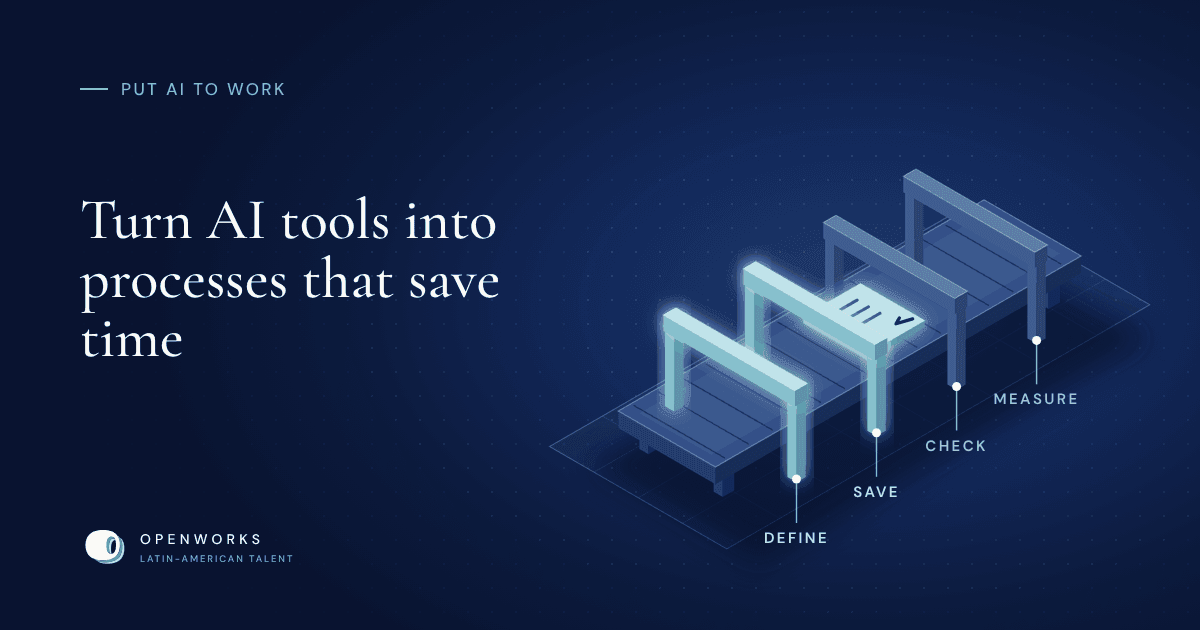
Take one task through four steps, then test it on real work for two weeks. First, define the task and what a finished result looks like. Second, save the instructions and a few good examples in one shared place. Third, name one person who checks the output. Fourth, measure the time saved once a month and decide whether to keep, adjust, or drop the process.
| Step | What gets written down | How you know it works |
|---|---|---|
| Define | The task, the input, and what done looks like | Two people describe the task the same way |
| Save | The instructions and a few good examples | A new teammate gets a useful result on the first try |
| Check | The name of the person who reviews the output | Every result has a reviewer |
| Measure | The time before and after, every month | The numbers show whether the process stays |
How can an owner tell whether a process really saves time?
Measure two numbers: minutes per task before the process, and minutes per task with it, including the time spent checking the output. Compare weeks with a similar workload, because a busy week distorts the result. If the saving is small, change the instructions or drop the task and move to the next candidate. Dropping a process after a fair test is a result, not a failure.
How does OpenWorks help owners build these processes with Assistify?
Assistify is OpenWorks's one-on-one AI coaching, delivered monthly so that an owner and team build their own AI solutions. The coaching works with the owner and the team, so the skills stay with the people who run the business and what gets built stays inside the company. When a solution needs more hands to implement it, OpenWorks can add dedicated developers in Latin America who work only for the client, in the client's time zone. The comparison below sets that approach against hiring a person locally to do the same job.
| Factor | Hiring locally | AI coaching with Assistify (OpenWorks) |
|---|---|---|
| Who builds the solutions | A local hire or a consultant | The owner and team, with a coach |
| Where the know-how stays | With the specialist you hire | With the owner and team |
| How support runs | A new local role | One-on-one coaching, every month |
| When more hands are needed | Another local hire | Dedicated developers in Latin America, in your time zone |
Key Takeaway
Pick one repetitive task, write down the steps, name a reviewer, and measure the time saved each month. Assistify gives owners one-on-one coaching to build that routine with their team.
Frequently Asked Questions
What is AI coaching for business owners?
AI coaching is one-on-one guidance that helps an owner and a team learn to use AI on their own work. At OpenWorks, Assistify is delivered monthly so the owner and team build their own AI solutions instead of waiting for someone else to build them. The goal is a set of written processes that the team runs without outside help.
Does a business need new software to start?
Not necessarily. Many owners already pay for AI tools and use them for a few tasks. A sound first step is to choose one repetitive task, write the steps, and test it with the tools the team already has. New software makes sense only when a written process shows a gap that the current tools cannot fill.
How long until a team sees time savings?
That depends on the task, and OpenWorks does not promise a number. The way to find out is to record how long the task takes today, test the new process on real work for two weeks, and compare the results. A monthly review then shows whether to keep, adjust, or drop the process.
How is AI coaching different from hiring an AI specialist?
A specialist builds solutions for the business, and the know-how sits with that person. Coaching teaches the owner and team to build their own, so the know-how stays in the company. When a solution needs more hands, OpenWorks can also add dedicated developers who work only for the client, in the client's time zone.
An owner can start this week by choosing one repetitive task, writing four steps, and testing them for two weeks. A free call with OpenWorks is a way to talk through which task to begin with.