

Quick Answer
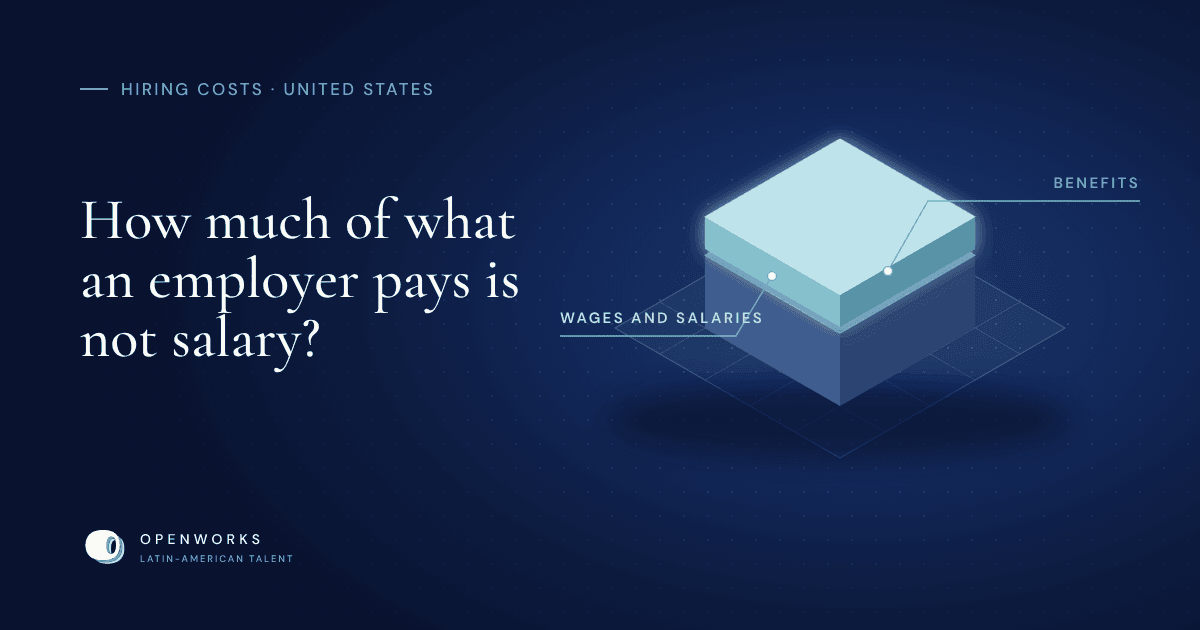
In June 2026, US private-industry employers paid an average of $46.89 per hour worked in total compensation. Wages and salaries were $32.82 (70.0%) and benefits were $14.07 (30.0%), so about 30 cents of every compensation dollar was not salary.
The US Bureau of Labor Statistics (BLS) publishes Employer Costs for Employee Compensation, a survey of what employers pay per employee hour worked. The figures below are national averages for private industry. They exclude the self-employed, private household workers and the agricultural sector, and they describe employees, not other work arrangements.
How much of an employer's cost is not salary?
30.0% of private-industry compensation cost in June 2026 was benefits: $14.07 of the $46.89 average per hour worked. For full-time workers the share was higher, at $17.03 of $54.00, or 31.5%. For part-time workers benefits were $5.05 of $25.20 per hour. Wages and salaries make up the rest.
- Paid leave: vacation, holiday, sick and personal leave.
- Supplemental pay: overtime and premium pay, shift differentials and nonproduction bonuses.
- Insurance: life, health, short-term disability and long-term disability coverage.
- Retirement and savings: defined benefit and defined contribution plans.
- Legally required benefits: Social Security, Medicare, federal and state unemployment insurance, and workers' compensation.
Data Point
US private-industry employers paid $46.89 per hour worked in June 2026: $32.82 in wages and salaries (70.0%) and $14.07 in benefits (30.0%).
U.S. Bureau of Labor Statistics, Employer Costs for Employee Compensation (2026)
What do the benefit costs include?
BLS groups benefits into five categories. Three of them have their own line in the June 2026 table for private industry: insurance at $3.69 per hour (7.9% of total compensation), paid leave at $3.54 (7.5%) and legally required benefits at $3.40 (7.2%). Supplemental pay and retirement and savings make up the rest of the 30.0%. BLS counts these costs for all workers, whether or not they use the plan.
| Category | What it covers | Share of total |
|---|---|---|
| Insurance | Life, health, disability | 7.9% |
| Paid leave | Vacation, holiday, sick | 7.5% |
| Legally required | Social Security, Medicare, unemployment | 7.2% |
| All benefits | Five categories combined | 30.0% |
What does this mean when comparing options to hiring locally?
The 30.0% is an average across all private-industry employees, so it is a reference point, not a quote for any single role. A salary posted for a role is one part of what an employer pays; the other part depends on the plan, the state and the person. OpenWorks' editorial view is that any comparison with hiring locally should ask what each option includes, because a figure that excludes benefits and one that includes them are not the same cost. BLS also states that, with data for December 2026, it will remove workers' compensation from the series, so later releases will not match these figures exactly.
Key Takeaway
In June 2026, benefits were 30.0% of what US private-industry employers paid per hour worked, and 31.5% for full-time workers. The figure is an average for employees, so a comparison with hiring locally should check what each option includes.
How Does Adding a Dedicated Team Member Compare With Hiring Locally?
OpenWorks places dedicated team members in Latin America who work only for the owner's business and in the owner's time zone. This is how OpenWorks works: it matches a person to the role, the owner directs the daily work in a staff augmentation arrangement, and a 90-day guarantee lets the owner swap the person if the match does not work out. When an owner compares that option with hiring locally, the useful question is what each side includes: wages, benefits, management time and what happens if the person does not work out. The BLS figure describes US private-industry averages and does not measure this option.
| Factor | Hiring locally | Dedicated team (OpenWorks) |
|---|---|---|
| Where candidates come from | The local applicant pool | Latin America |
| Time zone | The owner's own location | The owner's time zone |
| Who directs the daily work | The owner | The owner (staff augmentation) |
| If the match does not work out | The owner restarts the search | 90-day guarantee to swap the person |
Frequently Asked Questions
What percentage of employer compensation cost is benefits?
30.0% for US private-industry workers in June 2026, according to BLS. Benefits were $14.07 of $46.89 per hour worked.
Is the share different for full-time workers?
Yes. For full-time private-industry workers in June 2026, benefits were $17.03 of $54.00 per hour worked, or 31.5%. For part-time workers they were $5.05 of $25.20 per hour.
Does the 30.0% apply to a specific salary?
No. It is an average across all private-industry employees. The cost for one role depends on its plan, location and the person, so it works as a reference point and not as a quote.
Do these figures cover contractors or self-employed workers?
No. BLS excludes the self-employed from private industry and measures employer costs for employees. The figures do not describe contractor arrangements.
Will the BLS series change?
Yes. BLS states that with the March 2027 release of December 2026 data it will remove workers' compensation costs from the Employer Costs for Employee Compensation calculations. Later figures will not match June 2026 exactly.
OpenWorks, based in Langford, BC, builds dedicated teams in Latin America that work only for the client and in the client's time zone. For owners comparing that option with hiring locally, the useful first question is what each side of the comparison includes.