

Quick Answer
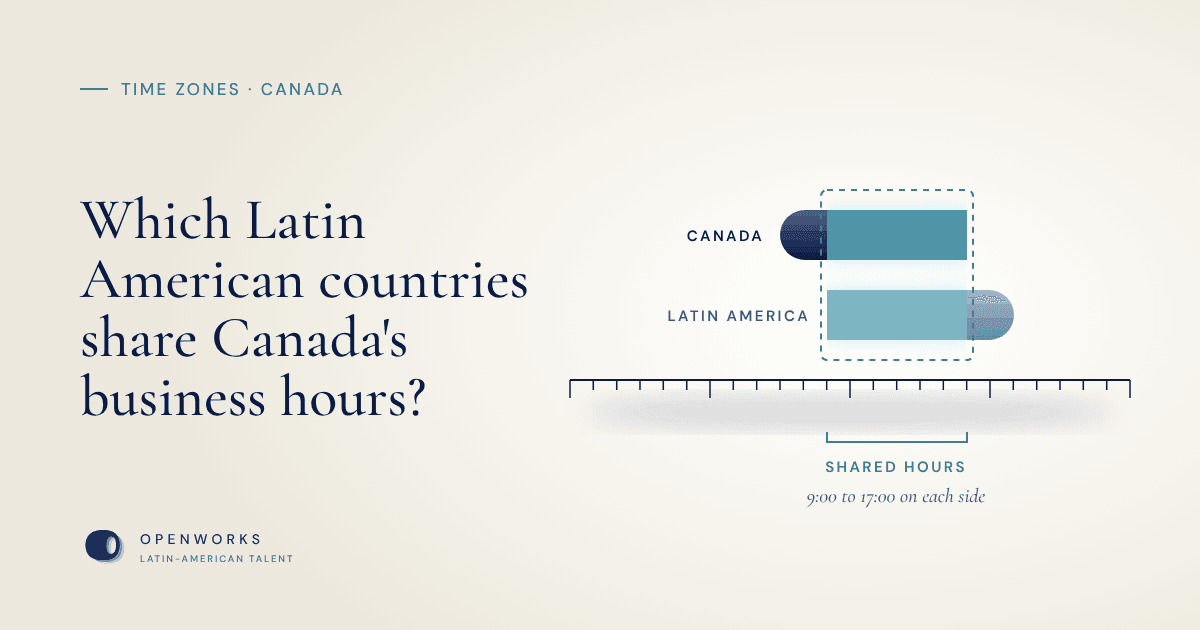
Colombia, Peru, Mexico City and Costa Rica are within two hours of every fixed-clock Canadian zone in this table, which gives 6 to 8 shared hours of a 9-to-5 day. Argentina and Brazil (São Paulo) are 2 to 4 hours ahead, which gives 4 to 6 shared hours. Offsets are as of November 2026.
In 2026 several Canadian provinces stopped changing their clocks. That makes the gap to Latin America constant through the year, which makes overlap easier to plan. The shared hours below are arithmetic: both sides work 9:00 to 17:00 local time, and overlap is eight hours minus the offset difference. The UTC offsets for Latin American countries come from the IANA time zone database, version 2026e.
Which Canadian provinces have a fixed clock now?
British Columbia uses Pacific time at UTC-7 year-round, with southeastern communities such as Cranbrook and Fernie staying on UTC-6 to align with Alberta. Alberta adopted permanent Alberta Time, UTC-6, with no change back in November 2026. Manitoba adopted Manitoba Standard Time at UTC-5, which is the same as the daylight time it used before. Saskatchewan has stayed on standard time since 1966, which is UTC-6.
Data Point
British Columbia uses UTC-7 year-round; Alberta has adopted permanent Alberta Time (UTC-6) and no longer resets to Mountain Standard Time; Manitoba Standard Time is UTC-5 and Manitoba will not turn its clocks back.
Governments of British Columbia, Alberta and Manitoba, time system pages (2026)
How many business hours do they share with Latin America?
The table counts shared hours of a 9:00 to 17:00 day. Ontario is shown for November to March, when it is on UTC-5; during daylight time it is one hour ahead, which adds an hour of overlap for Argentina and Brazil and removes one for Mexico City and Costa Rica. Ontario's eastern communities continue to change their clocks twice a year, according to the Ontario Ministry of the Attorney General as reported by HR Reporter. Quebec and the Atlantic provinces are not covered here.
| Country (UTC offset) | British Columbia | Alberta and Saskatchewan | Manitoba | Ontario, Nov to Mar |
|---|---|---|---|---|
| Colombia (UTC-5) | 6 hours | 7 hours | 8 hours | 8 hours |
| Peru (UTC-5) | 6 hours | 7 hours | 8 hours | 8 hours |
| Mexico City zone (UTC-6) | 7 hours | 8 hours | 7 hours | 7 hours |
| Costa Rica (UTC-6) | 7 hours | 8 hours | 7 hours | 7 hours |
| Argentina (UTC-3) | 4 hours | 5 hours | 6 hours | 6 hours |
| Brazil, São Paulo (UTC-3) | 4 hours | 5 hours | 6 hours | 6 hours |
What does the table leave out?
Chile is left out because it still changes its clocks, so its overlap shifts during the year. The table assumes standard 9-to-5 hours on both sides, and teams that start earlier or later will see different numbers. Time zone overlap says nothing about skills, language or availability. OpenWorks' editorial view is that a shared time zone is a practical requirement for real-time collaboration, and it is one of several things an owner should check.
Key Takeaway
Colombia, Peru, Mexico City and Costa Rica share 6 to 8 hours of a 9-to-5 day with BC, Alberta, Saskatchewan and Manitoba, and Argentina and Brazil share 4 to 6. The overlap is fixed through the year for these zones, so it can be planned once.
How Does OpenWorks Use Shared Time Zones?
OpenWorks places dedicated team members in Latin America who work only for the owner's business and in the owner's time zone. This is how OpenWorks works: it matches a person to the role, the owner directs the daily work in a staff augmentation arrangement, and a 90-day guarantee lets the owner swap the person if the match does not work out. Sharing working hours means the owner can give instructions and get answers during the same day. The time zone tables in this post describe geography and clock offsets; they do not measure how any provider organizes its teams.
| Factor | Hiring locally | Dedicated team (OpenWorks) |
|---|---|---|
| Where candidates come from | The local applicant pool | Latin America |
| Time zone | The owner's own location | The owner's time zone |
| Who directs the daily work | The owner | The owner (staff augmentation) |
| If the match does not work out | The owner restarts the search | 90-day guarantee to swap the person |
Frequently Asked Questions
Which Latin American countries are closest in time to Canada?
Mexico City, Costa Rica, Colombia and Peru. Against the fixed-clock Canadian zones in this table they share 6 to 8 hours of a 9-to-5 day.
How much overlap does Colombia have with British Columbia?
Six hours of a 9-to-5 day. British Columbia is on UTC-7 year-round and Colombia is on UTC-5 with no clock changes.
Do Argentina and Brazil work for a Canadian team?
They can, with a smaller shared window. Both are on UTC-3, giving 4 hours with British Columbia and 5 to 6 hours with Alberta, Saskatchewan and Manitoba.
Do all Canadian provinces have a fixed clock now?
No. British Columbia, Alberta, Manitoba and Saskatchewan do. Ontario's eastern communities still change their clocks, and Quebec and the Atlantic provinces are not covered in this post.
Where do the UTC offsets come from?
Canadian rules come from the provincial government pages. Latin American offsets come from the IANA time zone database, version 2026e.
OpenWorks, based in Langford, BC, builds dedicated teams in Latin America that work only for the client and in the client's time zone. If shared hours matter to your team, that is the first thing to settle.