
7 Questions to Ask Before Choosing a Nearshore IT Staff Augmentation Partner
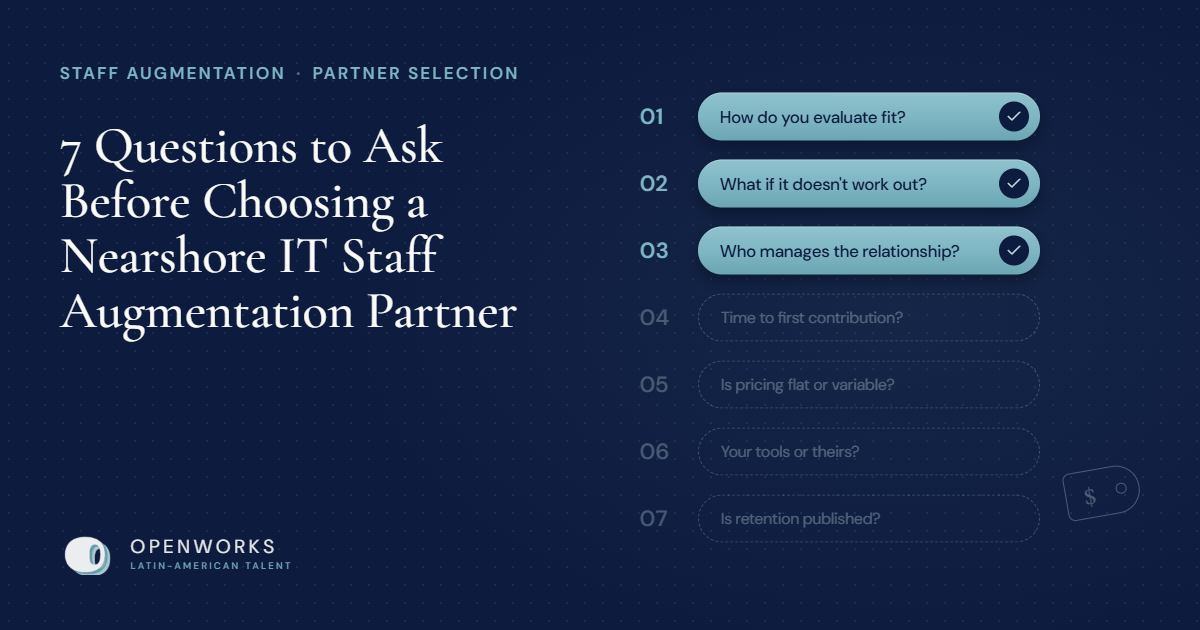
The questions that separate a good nearshore staff augmentation partner from a risky one are about vetting, replacement and ownership, not price.
Quick Answer
The questions that actually separate a good nearshore staff augmentation partner from a risky one aren't about price — they're about what happens before a candidate is presented (how technical fit and working style are actually vetted), and what happens after someone starts (who manages the relationship, and what happens if the match doesn't work out). Price is the easiest thing to compare and the least predictive of whether the hire sticks.
Most comparisons of outsourcing or staffing vendors default to generic criteria — team size, credentials, KPIs — built for categories like call centers or accounting BPO. Nearshore technical staff augmentation is a different kind of decision, because the thing being evaluated isn't a service level agreement, it's whether one specific person will actually fit your team.
What should you actually ask before choosing a nearshore staff augmentation partner?
The questions that matter are the ones that reveal what happens before you ever see a candidate profile, not what a sales deck promises. A partner that can answer these clearly, with specifics, is a different category of vendor than one that answers in generalities.
- How do you vet technical fit before presenting a candidate — not after? If the answer is "we screen resumes and send you the best matches," that's volume, not matching.
- What happens if the hire doesn't work out in the first few months? A real replacement policy is specific about timeline and conditions, not a vague "we'll help."
- Who manages the relationship after the person starts — you, or the partner? This determines whether staff augmentation actually removes management overhead or just adds another vendor to track.
- What's the realistic time to first meaningful contribution — not time to first candidate? Those are different numbers, and the gap between them is where most onboarding friction hides.
- Is pricing a flat monthly rate, or does it change based on hours, scope creep, or team size? Opaque pricing is a leading indicator of friction later.
- Does the person work inside your own tools and processes, or route through the partner's systems? This affects how fast someone becomes a real team member rather than someone you manage through a vendor.
- What's the actual retention rate for placements after 12 months — and is it published, or just claimed? Ask how it's calculated and over what period — a number without a method isn't evidence.
- Price comparisons are easy to find and the least useful signal — the questions above are harder to answer and far more predictive
- A partner that answers vaguely to questions 1-3 is optimized for placing someone fast, not for the match holding up
- Questions 4-7 reveal whether the partner's model actually removes management overhead, or just relocates it
Why does the vetting process matter more than the vendor's pitch?
Because the failure mode in nearshore hiring almost never shows up in the sales conversation — it shows up in month two, when a technical or cultural mismatch becomes visible and expensive to unwind. A partner that front-loads matching on technical fit, industry context, and working style before presenting anyone is solving for that failure mode directly. A partner that optimizes for speed-to-candidate is solving for a different metric entirely, and it isn't the one that predicts whether the hire still works out a year later.
| Factor | What generic vendor checklists typically cover | Nearshore Tech Staff Augmentation (OpenWorks) |
|---|---|---|
| What's being evaluated | Service levels, team size, certifications | One specific person's fit with your team |
| Vetting | Focuses on vendor credentials, not how each candidate is vetted | Fit is screened before a candidate is presented |
| Replacement policy | Rarely a line item | 90-day replacement guarantee |
| Tooling | Rarely asked | Works inside your own tools and processes |
| Retention figure | Rarely asked for | 98% at 12 months (OpenWorks clients) |
Key Takeaway
The questions that predict whether a nearshore hire works out are about process, not price — how fit is vetted before presentation, what happens if it doesn't work, and who owns the relationship afterward. A vendor that can't answer those specifically is optimized for something other than the hire lasting.
Frequently Asked Questions
What's the most important question to ask a nearshore staffing partner before signing?
How they vet technical fit and working style before presenting a candidate, not after. This single answer reveals whether you're getting a matched hire or a filtered resume list — the difference shows up in whether the person is still there in six months.
Does a nearshore staff augmentation partner handle onboarding, or is that on the client?
It depends on the model. In a staff augmentation model like OpenWorks', the partner front-loads alignment on stack, working style, and scope before the candidate starts, which is part of why the average runs around 3 weeks from first consultation to an integrated hire, rather than the longer timelines common with less structured onboarding.
What retention rate should you expect from a nearshore staff augmentation hire?
There's no universal benchmark — retention varies widely by partner and model, and many vendors don't publish a figure at all. OpenWorks reports 98% retention and 0% client churn after 12 months across its active client base.
Should cost be the deciding factor when comparing nearshore staffing partners?
No — cost is the easiest variable to compare and the one least correlated with whether the hire succeeds. OpenWorks clients save up to 50% on salaries compared with local hiring, but that only holds if the person placed is the right fit and stays.
OpenWorks places senior nearshore engineers with US and Canadian companies. It screens for technical skills, industry context, and working style before presenting candidates.
OpenWorks
Published on October 12, 2026