
What Should a Nearshore Staff Augmentation Replacement Guarantee Actually Cover?
A replacement guarantee is only as good as its clauses. Six terms to check before you sign a nearshore staff augmentation contract.
Quick Answer
A nearshore staff augmentation replacement guarantee should cover six things in writing: what triggers a replacement, when the clock starts and how long it runs, what the remedy is, the standard the replacement must meet, who covers the handoff, and what is excluded. The number of days is only part of the answer. The clauses behind it decide whether the guarantee protects you when a hire does not work out.
Most partners mention a replacement guarantee. Fewer explain it. For a CEO or CTO adding an engineer to a working team, the guarantee is the answer to one question: if this person is not the right fit, what happens next, and who bears the cost of finding out?
What is a replacement guarantee in nearshore staff augmentation?
It is a contractual promise that if a placed engineer does not work out within a defined period, the partner will provide a replacement. It is a contract term, not a feeling of goodwill, so the details matter. Two partners can both advertise a guarantee and offer very different protection.
Why does the guarantee matter in a nearshore engagement?
The cost of a mismatch is rarely visible in the first weeks. A technical or working-style gap tends to surface after the person has joined your sprints, touched your codebase, and absorbed time from your senior engineers. At that point, the guarantee decides how quickly you can recover and how much of the disruption lands on your team. It also shows how confident a partner is in its own matching.
What should a replacement guarantee actually cover?
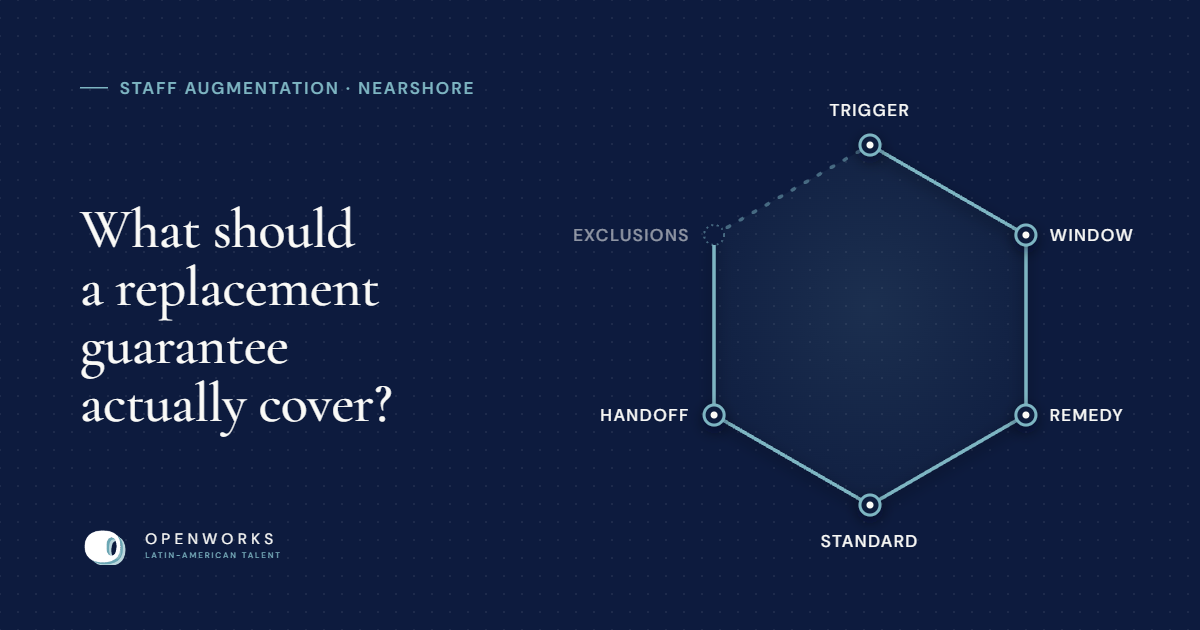
Six clauses decide how much protection you really have. Ask for each one in writing.
- What triggers a replacement? Check whether performance, fit, and resignation are all covered, or only one of them.
- When does the clock start, and how long does it run? Starting from the first working day protects you better than starting from contract signing.
- What is the remedy? A replacement candidate, a credit, or a refund are three different outcomes, and you should know which one applies.
- What standard must the replacement meet? It should match the seniority and stack of the original role, not simply be whoever is available.
- Who covers the handoff? Look for how knowledge transfer and overlap are handled, and how billing works during the transition.
- What is excluded? Some guarantees stop applying if the scope of the role changes after the hire starts.
How do you compare guarantees across partners?
Compare clauses, not days. A longer window with narrow triggers can protect you less than a shorter window with clear ones. This table turns the checklist into questions you can put to any partner.
| Clause | What to ask | Warning sign |
|---|---|---|
| Trigger | Which situations qualify for a replacement? | Only resignation is covered |
| Window | When does the period start and how long does it run? | The clock starts before the person has started working |
| Remedy | Do I get a replacement, a credit, or a refund? | The answer is "we will help" with no commitment |
| Replacement standard | Will the replacement match the original role's seniority and stack? | The replacement is whoever is available |
| Handoff | Who covers knowledge transfer and billing during the transition? | Overlap and billing during the transition are left undefined |
| Exclusions | What cancels the guarantee? | The list is long or not written down |
OpenWorks backs its placements with a 90-day replacement guarantee. It also screens for technical skills, industry context, and working style before presenting a candidate, so the guarantee is a backstop rather than the plan. OpenWorks reports 98% retention at 12 months across its active client base.
Key Takeaway
A replacement guarantee is a set of clauses, not a number of days. Ask what triggers it, when it starts, what the remedy is, what the replacement must match, who covers the handoff, and what is excluded. Get the answers in writing before you sign.
Frequently Asked Questions
What is a replacement guarantee in staff augmentation?
It is a contract term under which the partner provides a replacement if a placed engineer does not work out within a defined period. The protection depends on the clauses: what triggers it, when it starts, what the remedy is, and what is excluded.
How long should a replacement guarantee last?
There is no single standard, and windows differ by partner and contract, so compare the clauses rather than only the number of days. OpenWorks offers a 90-day replacement guarantee.
Does a replacement guarantee replace good vetting?
No. A guarantee limits the damage when a hire does not work out, but vetting reduces how often that happens. OpenWorks screens for technical skills, industry context, and working style before presenting candidates, and reports 98% retention at 12 months across its active client base.
Should the replacement guarantee be in the contract?
Yes. Ask for the triggers, the start of the period, the remedy, the replacement standard, the handoff, and the exclusions to be written into the agreement, not described in a sales conversation.
OpenWorks places senior nearshore engineers with US and Canadian companies.
OpenWorks
Published on October 21, 2026